The 2026 Pillar Guide

33 Restaurant Marketing Strategies to Boost Revenue in 2026

How to market a restaurant in 2026 — the complete playbook. Five pillars, 33 proven restaurant marketing ideas and strategies, and the proprietary CDP research that turns every guest interaction into compounding revenue. Modern marketing for restaurants has changed: this is the operating system 1,000+ chains run.

1,000+ restaurant locations $53K+ avg revenue recovery / location / yr 99.3% client retention
The Short Answer

Restaurant marketing in 2026 is the integrated practice of unifying guest data, automating marketing with AI, managing reputation in real time, and proving revenue with closed-loop attribution. Restaurants using this integrated approach recover an average of $53,000+ per location annually — and replace 3–5 separate tools with a single platform.

33 restaurant marketing strategies — guest data, marketing automation, and reputation management on one platform
38%
At-risk guest recovery rate
20+ hrs
Saved weekly per location
43%
Lifetime value lift
72
Net Promoter Score
The Five Pillars

One playbook. Five compounding loops.

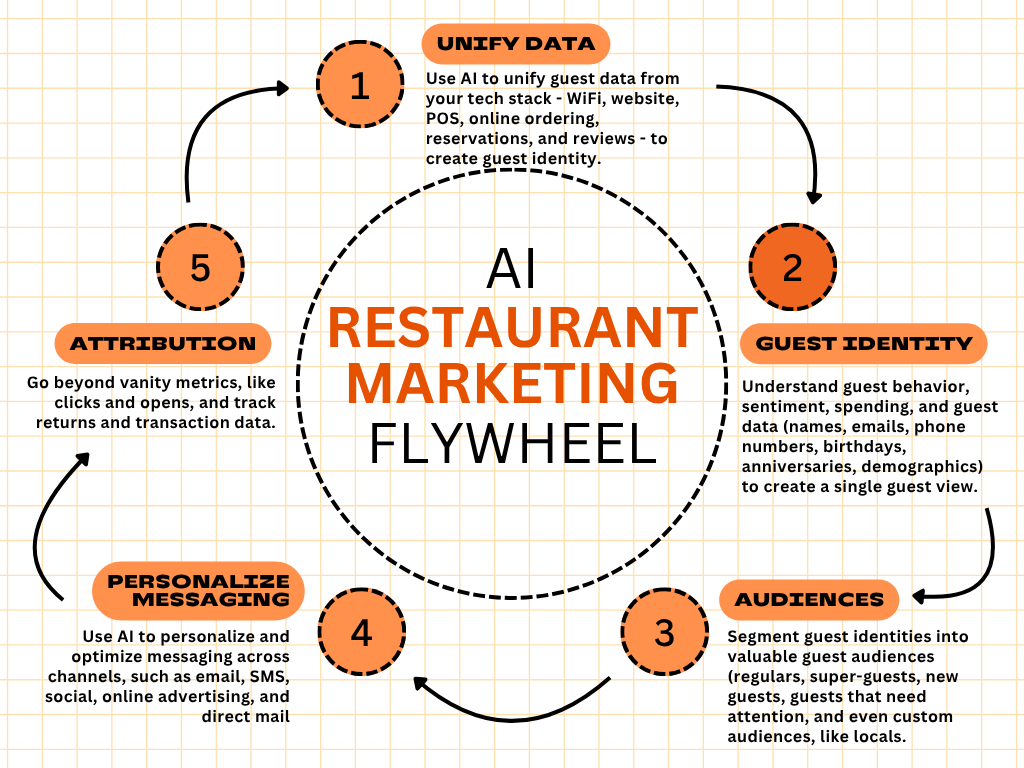
Each pillar feeds the next. Marketing fills the CDP. The CDP sharpens automation. Automation builds reputation. Reputation drives discovery. Attribution proves all of it — and the loop runs again, smarter.

The AI restaurant marketing flywheel — guest data, automation, reputation, and discovery compounding
The AI restaurant marketing flywheel — every loop reinforces the others.
Pillar One

Discoverability: Be the first answer.

Guests no longer “search” — they ask. ChatGPT, Perplexity, Google AI Overviews, Siri, and Alexa now decide which restaurants get recommended. Discoverability in 2026 means being the verified source those engines cite. The work happens on your website, your schema, and your reviews — not in your ad budget.

How to market a restaurant in 2026

How to market a restaurant in 2026 requires five integrated capabilities: AI search optimization (AEO), unified guest data, conditional workflow automation, AI-powered reputation management with multi-step surveys, and true closed-loop revenue attribution. Restaurants using this integrated approach recover an average of $53,000+ per location annually while replacing 3–5 separate marketing tools.

Strategy / 01

Optimize for AI search engines (AEO)

Add Speakable schema, FAQPage markup, and 29–42 word answer blocks at the top of every page. ChatGPT and Perplexity cite these blocks verbatim. Restaurants without AEO and AI search optimization disappear from AI answer engines entirely — the second-place algorithm doesn’t exist.

Cited by ChatGPT, Perplexity, Gemini, and Google AI Overviews
Strategy / 02

Optimize for voice assistants

Voice queries are conversational — “How do I find a great brunch spot near me?” Restaurants win voice by writing answers the way people speak them. Short sentences. Direct claims. Voice search optimization uses Speakable selectors on the snippets you want assistants to read aloud.

Captured on Siri, Alexa, and Google Assistant
Strategy / 03

Build a schema-powered website

Restaurant schema, MenuItem schema, Review schema, AggregateRating, LocalBusiness — every entity on your site labeled in JSON-LD. AI engines and search engines understand structure they can parse. Bloom’s AI restaurant website design plugin automates schema generation from verified CDP data.

Rich results in Google + cited entities in AI engines
Strategy / 04

Win local SEO and Google Maps

Eighty-two percent of “near me” restaurant searches convert within 24 hours. NAP consistency across 40+ directories, geo-modified content per location, and structured location pages with verified reviews — those are the restaurant SEO local pack inputs that compound.

Higher Maps placement + more “Directions” clicks
Strategy / 05

Optimize Google Business Profile + listings

Posts, photos, Q&A, attributes, services, menu — every Google Business Profile field filled. Google rewards completeness and freshness. Then syndicate the same verified data across Apple Business Connect, Yelp, TripAdvisor, Bing Places, and Facebook in one operation.

More profile views, calls, direction requests
Strategy / 06

Drive discovery through verified guest data

This is what no competitor can replicate: AI engines reward content powered by real transactions, real visits, and real sentiment. Bloom’s AI restaurant website plugin pulls verified restaurant CDP data into your pages so AI engines trust your authority — and recommend you over chains with thin data trails.

Defensible authority no competitor can match
Pillar Two

Guest Intelligence: Know who actually pays the bills.

Most restaurants treat every guest equally. The data says they shouldn’t. Behavioral segmentation reveals a brutal pattern — and unlocks the highest-leverage marketing in your calendar. Actionable restaurant marketing insights only emerge when guest behavior, transactions, and sentiment live in one identity-resolved system.

Original Bloom Research · Finding 01

The One-Visit Cliff: 77.8% of guests visit once and never return.

Source: Bloom CDP · verified May 2026

The remaining 22.2% of guests generate 66.5% of all tracked visits. The top 3% generate 40%. The top 0.15% generate 14%.

Every restaurant has a tiny segment of guests carrying the bulk of revenue — and most restaurants cannot identify them. Behavioral segmentation isn’t a “nice-to-have” feature. It’s the lens that reveals which 3% of your database is worth the next 12 months of your marketing budget.

77.8% of guests visited once · generate 33.5% of visits ~19% of guests visits 2–9 · generate ~26.5% of visits 3% of guests 10+ visits · generate ~40% of visits 0.15% · 100+ visits generate ~14% of visits
Strategy / 07

Unify guest data with a restaurant CDP

One identity-resolved profile per guest — across WiFi, POS, reservations, online ordering, reviews, and surveys. A CRM stores contacts; a restaurant customer data platform (CDP) knows guests. The first capability every modern restaurant needs.

360° view of every guest
Strategy / 08

Capture guest behavior at every touchpoint

WiFi marketing captures everyone who walks in — including the 95% who’d never opt into a loyalty app. POS captures spend and item-level preferences. Reservations capture occasion. Together they build a complete picture — who, when, what, how often, how much — fueling restaurant marketing campaigns that actually segment by behavior, not guesswork.

Passive data capture at scale
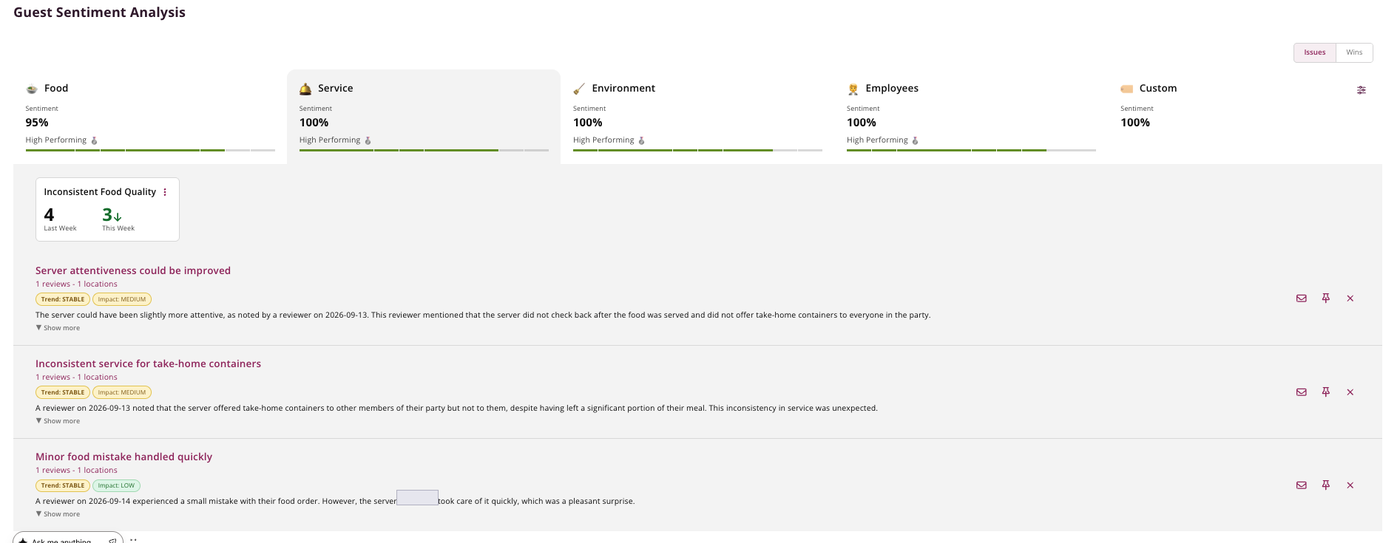
Strategy / 09

Build behavioral segments (RFM + sentiment)

Recency, Frequency, Monetary value — layered with sentiment scores. Restaurant marketing segmentation creates Super Guests, Regulars, New Guests, Guests Needing Attention, At-Risk, Lost segments that update continuously based on actual behavior, not static rules.

Dynamic segments, never stale
Strategy / 10

Identify and target high-value audiences

The One-Visit Cliff (above) is the ceiling most restaurants accept. Bloom’s smart audience segmentation surfaces the 22% of guests carrying the business — and the top 3% carrying the margin. Target them differently. Treat them like the asset they are.

Marketing focused where revenue lives
Strategy / 11

Predict churn and recover at-risk guests

Bloom’s AI predictive model assigns a churn probability to every guest based on visit cadence, recency, and behavior drift. When the score crosses threshold, a conditional workflow fires automatically. The platform recovers 38% on average.

38% at-risk recovery rate
Strategy / 12

Calculate true guest lifetime value

LTV isn’t average ticket × visits. It’s projected revenue across the entire guest relationship — adjusted for churn risk, segment behavior, and sentiment signals. Knowing guest lifetime value per segment changes every marketing decision you make.

43% lifetime value lift platform-wide
Strategy / 13

Reconnect with past visitors through smart remarketing

The first-to-fifth visit window (see Finding 05) is the highest-leverage marketing investment in your calendar. Welcome sequences, second-visit recovery, frequency-builder campaigns — every dollar spent on restaurant remarketing returns more than ad spend chasing new acquisition.

Higher ROI than new-guest acquisition
Original Bloom Research · Finding 05

The 5-Visit Threshold: A guest at visit 5 is worth 4.6× their first.

Source: Bloom CDP · verified May 2026

Lifetime value doesn’t grow linearly. It compounds — with the steepest gains in the first-to-fifth visit window.

By visit 10, a guest is worth 8.2× their first order. The compounding pattern is consistent visit by visit: V2 = 2.0×, V3 = 2.9×, V4 = 3.7×, V5 = 4.6×, V7 = 6.1×, V10 = 8.2×. The first-to-fifth window is the single highest-leverage marketing investment in any restaurant’s calendar. Welcome sequences, second-visit recovery, and frequency-building campaigns in that window outperform every dollar of new-guest acquisition spend.

10× 7.5× 2.5× V1 V2 V3 V4 V5 V6 V7 V8 V10 V12 First-to-Fifth window 4.6× The Loyalty Threshold
Pillar Three

Automation: Stop sending. Start branching.

Linear email sequences are dead. They send the same message on the same schedule no matter what the guest does. Modern restaurant automation branches — every guest, every step, every decision driven by actual behavior. The restaurants winning in 2026 run restaurant marketing campaigns on autopilot — birthday, win-back, post-visit, VIP — every send tied to a CDP segment.

Defined: Conditional Workflows

Workflows that ask questions — and route accordingly.

A conditional workflow is a visual automation builder where every step branches based on guest behavior. Did the guest open the email? Click? Return? Purchase? Each answer routes them down a different path. The same workflow can produce a thousand different journeys.

This is the technology behind Bloom’s 38% average at-risk recovery rate. Linear sequences can’t compete — they don’t know whether the guest came back.

38%
Average at-risk guest recovery rate
1
Trigger firesGuest hasn’t visited in 30 days
2
Win-back email sentVoice-of-the-Guest copy, brand-aligned
3
Branch on openOpened → wait 3 days. Not opened → SMS
4
Branch on clickClicked → smart coupon. Not clicked → second email
5
Branch on WiFi check-inReturned → exit workflow + thank-you. Still gone → escalate
6
POS attribution capturedRevenue tied to campaign automatically
Strategy / 14

Replace manual lists with conditional workflows

Stop building lists. Start building workflows. AI restaurant marketing automation defines the trigger and the branches; the system handles which guests qualify in real time. The list maintains itself.

Hours saved every week
Strategy / 15

Launch behavior-triggered email campaigns

Welcome sequence on first WiFi visit. Birthday on the actual day. Anniversary one year after first visit. Win-back at 30 days of inactivity. VIP recognition at the 5th visit threshold. Behavior-triggered restaurant marketing runs automatic, branded, and tracked to revenue.

Always relevant, never generic
Strategy / 16

Run SMS campaigns that convert

Restaurant SMS marketing open rates exceed 95% — but only when used surgically. Mobile marketing for restaurants succeeds when you reserve SMS for high-value moments: same-day reservations, smart coupon redemption windows, urgent operational comms. Conditional workflows handle the timing so you don’t burn the channel.

95%+ SMS open rates
Strategy / 17

Build win-back sequences for cooling guests

“Cooling off” is the segment between regular and at-risk. They’ve slowed down, but they’re still recoverable. Win-back remarketing caught early uses a soft nudge to bring them back. Wait until they’re at-risk and the cost-to-recover triples.

Caught before churn
Strategy / 18

Automate birthday, anniversary, VIP recognition

Birthdays generate the highest single-message conversion rates in restaurant marketing. Anniversaries are the silent gold mine — the day a guest first walked in, sent annually, drives a measurable repeat-visit lift. Automated VIP recognition campaigns deserve consistency.

Highest-converting message types
Strategy / 19

Run paid ads powered by first-party audiences

Meta and Google Custom Audiences powered by your CDP outperform interest-based targeting every time. Push your at-risk segment to Meta. Build lookalikes off your Super Guests. Suppress your active regulars. First-party audiences spend the budget where it actually matters.

2–4× return vs. interest targeting
Strategy / 20

Loyalty without an app

App-based loyalty captures the 5% of guests who’d download anything. The other 95% walk in and out of your data dark. WiFi-driven loyalty and multi-channel data capture from POS, reservations, website, and surveys captures the vast majority of your guests, recognizes returning guests automatically, and triggers rewards through email and SMS — no app required.

Loyalty for the other 95%
Pillar Four

Reputation + Voice of the Guest

Your review feed isn’t customer service — it’s the highest-resolution operational intelligence stream in your business. Most restaurants treat it as a chore. The best treat it as data.

Defined: Voice of the Guest

The engine that learns how your guests actually talk.

Voice of the Guest is Bloom’s continuously-running AI engine. It analyzes every review and survey response to extract the actual language your guests use about your restaurant. That language then powers your review responses, your email campaigns, your SMS messages, and your website copy — automatically.

The result: AI-generated content that sounds authentically like your brand. Not like a generic AI tool.

Proof of Engine · Original Research 02

1-star reviews contain 1.5× more written commentary than 5-star reviews.

Across 2026 aggregated reviews, 86% of 1-star reviews include written comments — versus only 58% of 5-star reviews. The operational intelligence hidden in your review feed is concentrated where most restaurants are least equipped to extract it: in your worst guest experiences.

5★ 4★ 3★ 2★ 1★ 58% 70% 78% 82% 86% % of reviews including written commentary, by star rating
Original Bloom Research · Finding 03

The Platform Rating Gap: ratings vary 0.71 stars between platforms.

Source: Bloom CDP · verified May 2026

Tock guests rate 4.78 on average. Yelp guests rate 4.07. A 21% differential — describing the same restaurant.

Restaurants benchmarking against a single platform — particularly Yelp — have a systematic blind spot. A Yelp 4.0 and an OpenTable 4.6 can describe the exact same restaurant. Unified review aggregation is the only way to see your true sentiment baseline. Anything less, and you’re optimizing against a biased signal.

Tock Facebook OpenTable Google TripAdvisor Yelp 4.78 4.68 4.56 4.43 4.38 4.07 0.71★
Original Bloom Research · Finding 04

The 5-Star Baseline: 67.7% of restaurant reviews are 5-star.

Source: Bloom CDP · verified May 2026

Below 67.7% in your 5-star share, you don’t have a quality gap — you have a sentiment management gap.

You’re producing the same guest experience but failing to convert it into captured positive sentiment. Conversely, the 6.4% of reviews that are 1–2 star are where every operational signal lives. Three numbers govern your reputation health: 5-star share above 67.7%, 1–2 star share below 6.4%, and average review-response time measured in minutes, not days.

67.7% 5-STAR BASELINE Industry-wide
Strategy / 21

Consolidate every review into one dashboard

Google, Yelp, OpenTable, TripAdvisor, Facebook, Tock — six platforms minimum. Stop monitoring six tabs. AI restaurant reputation management surfaces patterns no single platform reveals (see the 0.71-star gap above) and lets you respond in one place.

15–20 hours saved weekly on reviews alone
Strategy / 22

Generate brand-voice review responses in minutes

Voice of the Guest learns your brand’s language. AI-generated review responses mention the specific dish, the specific staff member, the specific experience — sounding authentically like you, not like a chatbot. Auto-publish or hold for approval. Response time drops from days to minutes.

Response time: days → minutes
Strategy / 23

Capture feedback before it becomes a public review

Multi-step surveys (see below) reach guests within 24 hours of a visit — before they post anywhere public. Catch the unhappy guest privately. Recover them with a smart coupon. Convert the happy guest into a new-guest referral with a one-tap deep link.

Negative reviews caught before publication
Strategy / 24

How to respond to negative reviews

Acknowledge the specific complaint. Don’t deflect. Don’t argue. Offer a private channel to resolve. Then — the part most restaurants miss — feed the negative review back into operations. Per Finding 02, your worst reviews carry your richest data. Use it.

Recover guest + improve operations
Strategy / 25

Use sentiment, behavior, and transactions analysis to drive operational decisions

AI categorizes every comment by topic — food, service, cleanliness, ambiance, staff. Customer sentiment analysis surfaces trends by location. “Over-seasoned burgers” mentioned 12× at Midtown this month, at noon on Mondays, and burger sales are down 6%? That’s an alert before it becomes a rating problem. The review feed + behavior + transactions becomes your earliest operational radar — before issues hit your bottom line.

Operational fixes before P&L damage
Strategy / 26

Multi-step surveys: NPS by segment, not average

NPS as a single number is a lie. Multi-step surveys segment every metric by guest tier — Super Guests +72, Regulars +56, At-Risk –14. That spread is where guest identity + sentiment-driven decisions live. The flat number hides the truth.

NPS that actually tells you what to do
Strategy / 27

Build a five-star engine

Per Finding 04, 67.7% is the industry-wide 5-star baseline. Restaurants above it have a reputation engine. Restaurants below it have a sales-impacting problem. Use restaurant social proof workflows and operational alerts to close that gap measurably.

5-star share above industry baseline
T
Guest visitsWiFi check-in captures visit + identity
+2h
First survey question“How was your visit?” — 1 question, 1 tap
+1d
Branch on score4–5: Google review prompt. 1–3: private feedback flow
+2d
Targeted follow-upEach answer tagged with CDP segment, automatically
Recovery campaign firesUnhappy guest? Smart coupon + manager outreach trigger
Defined: Multi-Step Surveys

The earliest warning signal in your stack.

Multi-step surveys capture guest experience in progressive stages within 24 hours of a visit — earlier than any public review. Each response is automatically tagged with the guest’s CDP segment, so every metric is segmented by guest value tier rather than averaged.

NPS is no longer a flat number. It’s Super Guests +72, Regulars +56, At-Risk –14 — with one-click recovery campaigns triggered automatically based on the score and the segment.

24h
Feedback captured before guests post publicly
Pillar Five

True Attribution: Stop estimating. Start verifying.

Email opens are vanity. Click-through rates are vanity. The only metric that matters is verified revenue per campaign — traced through return visits and POS transactions. That’s the difference between a marketing tool and a revenue operating system.

Defined: True Attribution

Closed-loop revenue. Verified at every step.

True Attribution traces every campaign from email send through return visit (verified via WiFi check-in) through POS transaction (verified via integrated point-of-sale data) to specific items purchased. Every dollar attributed is verified, not estimated.

This is the difference between a marketing tool that reports email opens and a revenue operating system that proves campaign-driven revenue. It’s also why Bloom maintains a 99.3% client retention rate.

$53K+
Avg verified revenue recovery / location / year
1
Campaign sentEmail / SMS / paid ad fires from workflow
2
Guest opens / clicksCaptured at the guest profile level — not aggregated
3
Guest visits restaurantWiFi check-in confirms in-venue presence
4
POS transaction capturedToast / Revel integration records ticket + items
5
Revenue attributedEvery dollar tied to the campaign that drove it
Data feeds the next campaignThe flywheel turns — and the next round is smarter
Strategy / 28

Implement true attribution from day one

Most restaurants discover attribution at quarter-end and scramble. The platforms that get this right wire it in at launch. WiFi sensor + POS integration + email/SMS platform unified — that’s the AI restaurant CDP architecture. Don’t bolt it on later.

Verified ROI from day one
Strategy / 29

Track campaign-driven revenue (not just opens)

Every campaign in Bloom marketing automation reports four numbers: sends, opens, returns (verified by WiFi), and revenue (verified by POS). The first two are interesting. The second two are decision-grade. Optimize against the second two.

Decision-grade campaign data
Strategy / 30

Benchmark against industry baselines

67.7% 5-star share. 38% at-risk recovery rate. 4.6× LTV at visit 5. These are real numbers from a real platform. Benchmarking against industry baselines surfaces where you’re underperforming — and where you’re already winning.

Compete against the platform, not yourself
Strategy / 31

Calculate marketing ROI per location

Average across locations and you hide the underperformers. Per-location marketing ROI surfaces the real story: this location’s marketing is printing money, that one needs intervention. Run interventions where they matter; ignore the rest.

Focus interventions where they matter
Strategy / 32

Measure what actually drives repeat visits

Discount-driven repeat visits aren’t repeat visits — they’re rentals. True repeat behavior is recency lift independent of incentive. Bloom’s attribution model isolates organic frequency from discount-induced frequency, so you optimize for the right thing.

Real loyalty, not rented loyalty
Strategy / 33

Build the continuous improvement loop

The final pillar isn’t a tactic — it’s a cadence. Review attribution weekly. Tune workflows monthly. Audit sentiment quarterly. The platforms that compound win. The platforms that “set it and forget it” drift. Kaizen is the operating system underneath the operating system. Read the restaurant marketing blog for the next round of plays.

Compounding advantage over time
Run the math on your own numbers

Your projected annual recovery

Across 1,000+ locations and 142 actively-marketed restaurants, the Bloom platform average is $53,000+ in revenue recovered per location per year through closed-loop POS attribution. Adjust for your reality below.

Projected annual recovery $265,000 Across 5 locations · $45 avg ticket · platform baseline applied
See verified attribution live in your data

Estimate based on Bloom’s verified platform baseline of $53,000 average revenue recovered per location per year, scaled by location count and adjusted by ticket size (bounded between 0.6× and 2.0× of the $45 platform reference ticket to keep estimates realistic). Recovery represents campaign-attributed revenue from win-back, birthday, VIP, and behavioral-trigger campaigns, verified at the transaction level by closed-loop POS attribution. Your actual recovery depends on your guest segment distribution, at-risk guest count, and existing marketing baseline — and is verified within 90 days of deployment.

What Customers Say

Restaurant operators in their own words.

Five named operators on what changed when they ran the playbook. Real quotes. Real names. 99.3% client retention isn’t an accident.

SaaS that covered so many bases for us instead of having to use multiple software products. Bloom Intelligence has simplified our responses to reviews, customer feedback, and more. I highly recommend Bloom Intelligence.
Robert Sanderson
Restaurant Operator
Bloom Intelligence really is a step ahead in terms of marketing software and metrics. Their product is reliable, fast and innovative and has helped the company I work for really grow.
John Marchetti
Restaurant Marketer
Working with Bloom Intelligence has been amazing. They assist you every step of the way and work with you hand in hand to make sure you are optimizing your advertising potential.
Ariel Ramirez
Restaurant Operator
In these challenging times, it has been a pleasure working with Bloom Intelligence to help facilitate our service offering to our clients. They were extremely responsive and provided support to mitigate risk and minimize revenue loss. Great partner!
Stefan Kim
Hospitality Partner
We’re extremely pleased with the wealth of customer data that we’re able to gather, at a very attractive price. A “no-brainer” for anyone working with limited Marketing $$.
Bob Cross
Vice President of Operations
4.9★ Google · 78+ reviews 4.7★ G2 · 24 reviews 99.3% client retention Read full case studies →
The Strategic Position

We’re not another tool in your stack. We’re the intelligence layer on top of it.

Restaurant operators don’t have a software problem. They have a fragmentation problem. Five middleware vendors collecting fragments of guest data, none of them talking to each other, none of them tied to revenue. Bloom replaces the middleware — not your foundation.

For CEOs, Founders & Operators

The boundary is sharp. On purpose.

You’ve already invested in the foundation: POS, payments, reservations, your website. We don’t compete with any of it. We make all of it perform.

What Bloom is NOT Your foundation — keep what works
  • Your POS system We integrate with Toast, Revel, and more — and feed every transaction back into the CDP.
  • Your payment processor We don’t touch your money. We just help you make more of it.
  • Your website CMS Keep WordPress, Wix, Squarespace, or whatever you have. Our AEO/SEO layer makes it discoverable.
  • Your reservation platform OpenTable, Tock — we integrate. Your bookings become guest profiles automatically.
  • Your review platforms Google, Yelp, OpenTable, Facebook, TripAdvisor, Tock — we read every review, respond in your voice, and feed sentiment into operations.
What Bloom IS Your intelligence + agentic AI layer
  • The unified Customer Data Platform 22+ sources collapse into one identity-resolved guest profile. The data asset that compounds every day it runs.
  • The agentic AI that drives discoverability Get cited in ChatGPT, Perplexity, Google AI Overviews, and voice search — using your verified guest data as authority signal.
  • The marketing automation that prints revenue AI writes, segments, sends, and optimizes every campaign — email, SMS, paid social — attributed to actual transactions. 38% at-risk recovery rate.
  • The reputation engine that protects the brand Every review across every platform answered in your brand voice, in minutes — and the sentiment patterns feed back into operations alerts.
  • The operational intelligence that prevents P&L damage Cross-references guest behavior, transactions, and sentiment to spot operational issues — 30–60 days before they hit your revenue.
The Consolidation Math

What we DO replace: the disconnected middleware draining your budget.

Five vendors. Five logins. Five contracts. Five renewal cycles. Zero data flow between them. This is the typical restaurant marketing stack — and the operators replacing it with Bloom are reducing spend by 60–80% while running 10× more sophisticated marketing.

The Typical Stack 5 separate vendors

Five vendors. Five logins. Zero data flow.

  • Email marketingMailchimp / Constant Contact
  • SMS platformAttentive / EZ Texting
  • Review managementBirdeye / Marqii
  • Analytics & CDPBikky / Fishbowl
  • Website + AEO/SEOPopmenu / BentoBox
Typical total $15K+ / month
The Bloom Way 1 unified intelligence layer

One system. Every interaction compounds.

  • Unified Customer Data Platform
  • AI marketing automation (email + SMS)
  • AI reputation management across 6+ review platforms
  • AI website discovery (AEO + SEO + Voice)
  • Predictive analytics + operational alerts
  • Closed-loop POS revenue attribution
  • WiFi marketing + multi-step surveys
  • Voice of the Guest brand-voice AI
Starting at $105 / location / month

More capability. Unified data. A fraction of the cost. And every guest interaction makes the next one smarter.

Common Questions

Twenty questions, answered straight.

No fluff. Direct answers to the questions restaurant operators actually ask. Voice-search optimized versions live in the page schema for AI assistants like ChatGPT, Perplexity, Siri, and Alexa.

The best marketing strategy for restaurants is unifying guest data from every channel — WiFi, POS transactions, online ordering, reservations, waitlists, and your website — into one identity-resolved profile, then automating behavior-triggered campaigns against it. WiFi captures the in-venue guests loyalty apps miss. POS confirms what they ordered and how much they spent. Reservations and waitlists add intent and occasion. Combined, that’s the multi-channel intelligence that drives 38% at-risk recovery and $53K+ revenue recovery per location.
Restaurant remarketing is a powerful way to connect with visitors to your website or customers who have logged into your WiFi. It allows you to send targeted advertising and behavior-driven promotions to those people through online advertising or email marketing. It is a key marketing concept that should be a primary focus of restaurant owners and marketers.
Restaurant customer segmentation subdivides your customer base into specific groups based on demographics, psychographics, and behavior data. The richer the data sources — WiFi, POS, online ordering, reservations, waitlists, website, reviews — the sharper the segments. RFM (recency, frequency, monetary) layered with sentiment unlocks dynamic groups like Super Guests, Regulars, At-Risk, and Lost — and lets you personalize every campaign accordingly.
The best way to implement a digital smart coupon program is through a unified guest data platform like Bloom that triggers one-time-use codes based on multi-channel behavior — a guest captured via WiFi, online ordering, reservations, or waitlist who hits a behavior threshold (45 days since last visit, dropped frequency, abandoned reservation) receives a personalized code stored on their mobile device, redeemable on next visit and attributed back to POS revenue.
Optimize a restaurant for AI search by adding Speakable and FAQPage schema, writing definitive 29–42 word answer blocks in the first 300 words of every page, structuring content with semantic headings, and powering content with verified guest data. Bloom Intelligence automates restaurant AEO, SEO, and voice search optimization on every page of every Bloom-managed restaurant website.
True Attribution is closed-loop measurement that traces every campaign from send through return visit (WiFi check-in) through POS transaction through specific items purchased. Every dollar attributed is verified, not estimated. Bloom’s True Attribution architecture is the difference between a marketing tool and a revenue operating system.
Conditional workflows are visual automation builders where every workflow branches based on guest behavior. Instead of linear sequences, conditional workflows ask questions (did the guest open the email? did they visit? did they purchase?) and route guests down different paths automatically. Bloom’s AI restaurant marketing automation recovers an average of 38% of at-risk guests.
Voice of the Guest is Bloom’s continuously-running AI engine that analyzes every review and survey response to extract the actual language guests use about your restaurant. The extracted language powers brand-aligned AI review responses, email campaigns, SMS messages, and website copy without manual editing.
Multi-step surveys capture guest experience in progressive stages within 24 hours of a visit — earlier than any public review. Each response is tagged with the guest’s CDP segment, so every metric is segmented by guest value tier. NPS is not a flat number; it is Super Guests +72, Regulars +56, At-Risk –14 — with one-click recovery campaigns triggered automatically through sentiment-driven workflows.
Restaurant marketing platforms range from $95 to $225 per location per month for full-stack platforms like Bloom Intelligence. The right benchmark is not price but ROI — Bloom delivers an average $53,000+ revenue recovery per location annually, consolidating 3–5 separate tools (email, SMS, reputation, CDP, automation) into one platform. Run the numbers for your locations with the Bloom ROI calculator or see the full pricing breakdown.
Restaurant marketing automation begins delivering results within 5–7 days of activation. Days 1–2: connect data sources. Days 3–5: AI auto-populates guest profiles and creates smart segments. Day 5+: revenue growth begins as automated campaigns activate and at-risk guests are recovered. Full ROI typically realized within 60–90 days.
A restaurant CRM stores contact records and tracks deals — built for sales teams. A restaurant CDP unifies guest data from every touchpoint (WiFi, POS, online ordering, reservations, waitlists, website, reviews) into identity-resolved guest profiles with behavioral signals — built for marketing and operations. The CDP is what restaurants in 2026 actually need.
AI restaurant marketing uses artificial intelligence to write marketing campaigns, generate review responses in brand voice, predict at-risk guests, segment audiences automatically, and optimize website content for AI search engines. The result is the output of an expert marketing team at a fraction of the cost and time — a novice one-person marketer with the leverage of a full enterprise team.
Measure restaurant marketing ROI through closed-loop attribution that traces each campaign from send through return visit (captured via WiFi, online ordering, reservation, or waitlist) to POS transaction. Every channel ties back to the same identity-resolved guest profile, so a campaign send becomes a measurable revenue event. Track revenue per campaign, not opens or clicks. Bloom Intelligence delivers verified revenue recovery averaging $53,000+ per location annually. Use the Bloom ROI calculator to project the recovery for your specific locations.
Restaurant WiFi marketing uses branded WiFi landing pages to capture guest contact information and behavior data as guests connect at your locations. WiFi captures everyone who walks in — including the 95% who would never opt into a loyalty app — building the largest passive guest data asset available to restaurants. Across the Bloom platform, WiFi has captured 88M+ foot traffic sessions feeding 108M+ verified guest records. WiFi is one of six guest capture channels in Bloom’s CDP — alongside POS, online ordering, reservations, waitlists, and website — and they compound together into a single identity-resolved profile per guest.
The most important restaurant marketing trends for 2026 are AI search optimization (AEO) so restaurants surface in ChatGPT and Perplexity, unified guest data platforms that turn fragmented signals into identity-resolved profiles, conditional workflow automation, AI-powered reputation management with multi-step surveys, and true closed-loop revenue attribution from WiFi check-in to POS transaction. The restaurants running all five compound their advantage every month.
Market a restaurant on social media by pairing native platform content (Instagram, TikTok, Facebook) with behavior-triggered campaigns built on multi-channel guest data. The restaurants that win social use Voice of the Guest language extracted from real reviews, retarget guests captured across WiFi, POS, online ordering, reservations, waitlists, and website via paid social, and measure attribution back to closed-loop POS revenue — not just likes or follows.
Marketing a restaurant on Facebook works best when you upload your CDP-built custom audiences — guests unified from WiFi, POS, online ordering, reservations, waitlists, and website — for lookalike targeting, retarget those high-intent profiles with location-specific offers, and respond to every Facebook review in your brand voice within minutes. The platform’s ad targeting is only as good as the multi-channel guest data you feed it.
Market a new restaurant by capturing every opening-week guest into a unified profile from day one — via WiFi sign-in, POS receipt match, online ordering, reservations, waitlists, and website forms — then triggering automated welcome and second-visit sequences. The biggest mistake new restaurants make is acquiring guests they never recapture. Build the multi-channel guest database before the marketing spend.
Market a small restaurant by giving a single-person marketing function the leverage of an enterprise team through automation. Small restaurants don’t fail at marketing because of budget — they fail at retention. Use a CDP and marketing automation platform that unifies WiFi, POS, online ordering, reservations, waitlists, and website data — starting at $95/location/month — to compound every guest into a returning regular.
Get the Demo

Stop running five tools. Run the operating system.

A 30-minute demo, tailored to your locations and your existing tech stack. We’ll pull live CDP analytics for restaurants like yours, show you the strategies from this playbook in action, and quantify the revenue recovery you’re leaving on the table.

4.9★ Google 4.6★ G2 99.3% client retention 72 NPS